

ISAC and S1/NG Signalling: Why Identity-Native Detection Must Lead in 5G and 6G
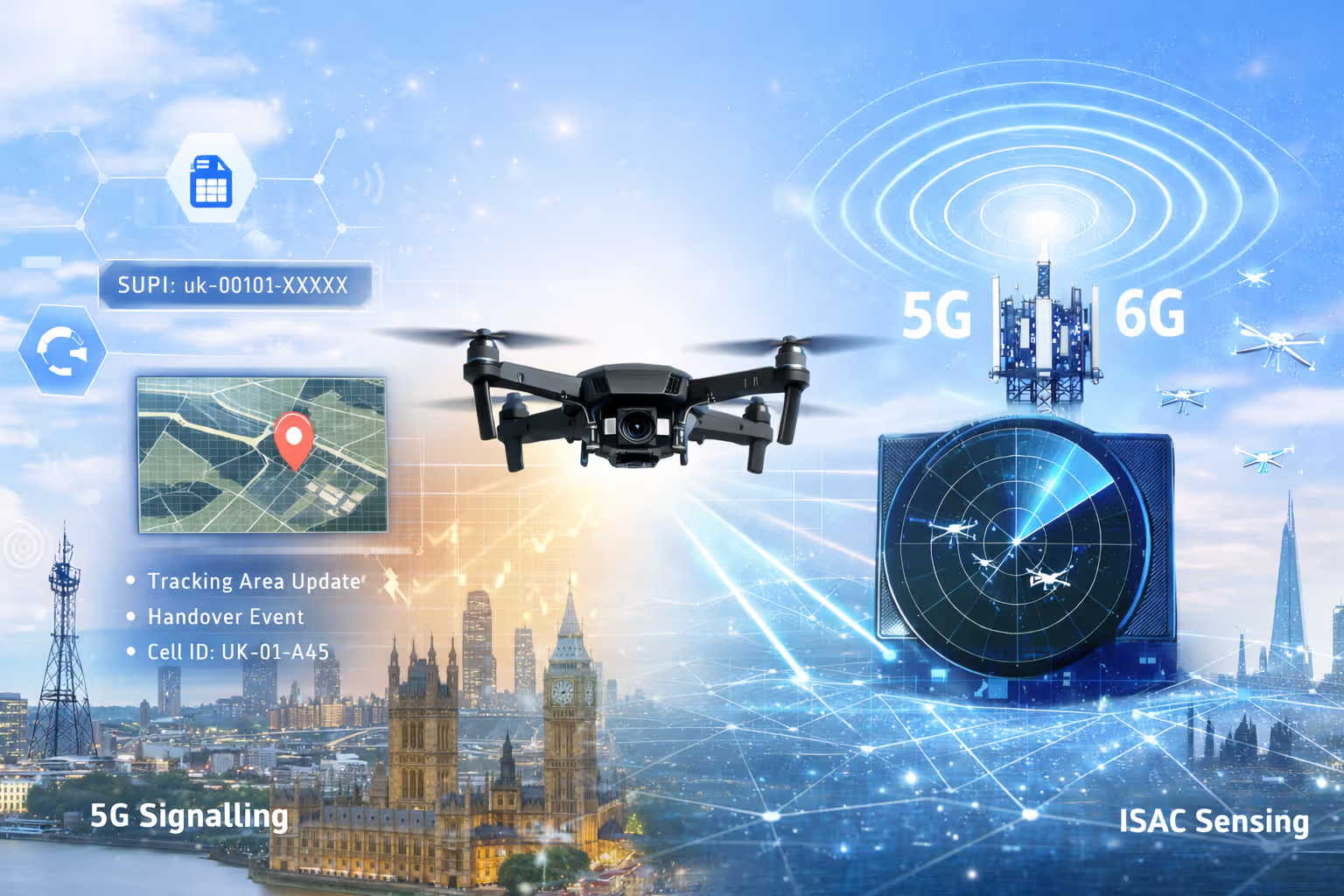
As 5G evolves toward 5G Advanced and, ultimately, 6G, Integrated Sensing and Communication (ISAC) is rightly attracting attention. The ability of the radio access network to detect airborne objects using sensing techniques is an important development.
However, when it comes to cellular-controlled drones, control plane signalling analysis must remain the primary detection method. ISAC should be viewed as a powerful secondary corroboration layer.
Control plane signalling provides something that sensing alone cannot: identity.
Every device attached to an LTE or 5G network generates S1 or NG signalling — attach procedures, handovers, path switches, tracking area updates and RRC state transitions. For a drone controlled over a mobile network, this activity is unavoidable. It creates persistent network identity (IMSI/SUPI level), produces observable mobility behaviour across sectors and geography, and establishes continuity over time.
Crucially, signalling analysis allows a drone to be detected without physically seeing it.
Even if a drone is beyond visual line of sight, outside radar geometry, or operating in cluttered environments, its control plane behaviour remains observable. By analysing handover cadence, sector transitions and mobility dynamics, unusual aerial movement can be identified and its approximate location inferred from network topology. Detection does not depend on direct physical observation.
This is strategically decisive.
Because signalling binds behaviour to a specific network identity, it enables:
• Persistent tracking
• Subscriber or device identification under lawful authority
• The possibility of targeted defeat or interdiction
Once the controlling subscriber or device identity is established within the operator domain, authorised interventions become technically feasible. That is not possible from sensing alone. ISAC may detect an airborne object, but it does not inherently reveal who is controlling it.
ISAC remains highly valuable. It provides physical corroboration — confirming that something is airborne in a given sector and time window. It can reduce false positives and strengthen evidential confidence. It answers the question, “Is there an object in the air?”
Signalling answers the more operationally important question, “Which network identity is responsible, and how has it behaved?”
The most resilient architecture places signalling analysis at the core of detection and attribution, with ISAC acting as a complementary sensing layer that enhances and corroborates the operational picture where available.
As 5G Advanced introduces sensing pilots and 6G moves toward sensing-native design, the networks that lead will be those that understand this hierarchy. Physical sensing enhances situational awareness. Identity-native signalling analysis enables control, attribution and, where authorised, intervention.
For cellular-controlled drones, detection begins inside the network. ISAC strengthens the evidence. Signalling defines the outcome.