

Signal Cloud Technical Primer
Privacy-Preserving Analytics for LTE and 5G Signalling
Introduction
Mobile networks operate through a complex system of control-plane signalling that coordinates how devices attach to the network, move between cells, and establish communications sessions. In LTE networks this signalling is exchanged across the S1 interface using the S1 Application Protocol (S1AP), while in 5G networks equivalent functions are provided through the NG Application Protocol (NGAP) on the N2 interface.
These signalling exchanges form a detailed operational record of how devices interact with the mobile network. Every registration procedure, mobility event, session establishment, and context release generates signalling messages that describe both device behaviour and network state. Despite the richness of this information, signalling data has historically been used primarily for operational troubleshooting and protocol analysis rather than large-scale behavioural analytics.
Signal Cloud from Melrose Networks is designed to change this model. The platform enables mobile network operators to analyse LTE and 5G signalling activity at national scale while maintaining strict control over subscriber identity information. By introducing a privacy-preserving processing pipeline, Signal Cloud converts raw signalling traffic into structured datasets that can support advanced analytics without exposing sensitive subscriber identifiers.
Signalling as a Network Data Source
Control-plane signalling provides a unique perspective on mobile network activity. Unlike user-plane traffic, which carries the content of communications, signalling messages describe the interactions between devices and the network infrastructure. As a result, signalling data captures the lifecycle of device connectivity.
In LTE networks, S1AP signalling is exchanged between eNodeBs and the Mobility Management Entity (MME). These messages coordinate procedures such as device attachment, bearer establishment, mobility management, paging, and handover. When a device initially connects to the network, the signalling exchange establishes the context through which subsequent communication sessions will occur. As the device moves through the network, further signalling messages coordinate handovers and mobility updates.
The 5G architecture performs similar functions using NGAP signalling exchanged between gNodeBs and the Access and Mobility Management Function (AMF). Although the protocols differ in structure, the underlying concepts remain consistent. Devices register with the network, establish sessions, and move across cells while the control plane coordinates these actions through signalling procedures.
Over time, these procedures produce a continuous stream of events that describe how devices behave within the network environment. When analysed at scale, these events can reveal mobility patterns, anomalous behaviour, and operational trends.
Signal Cloud Architecture
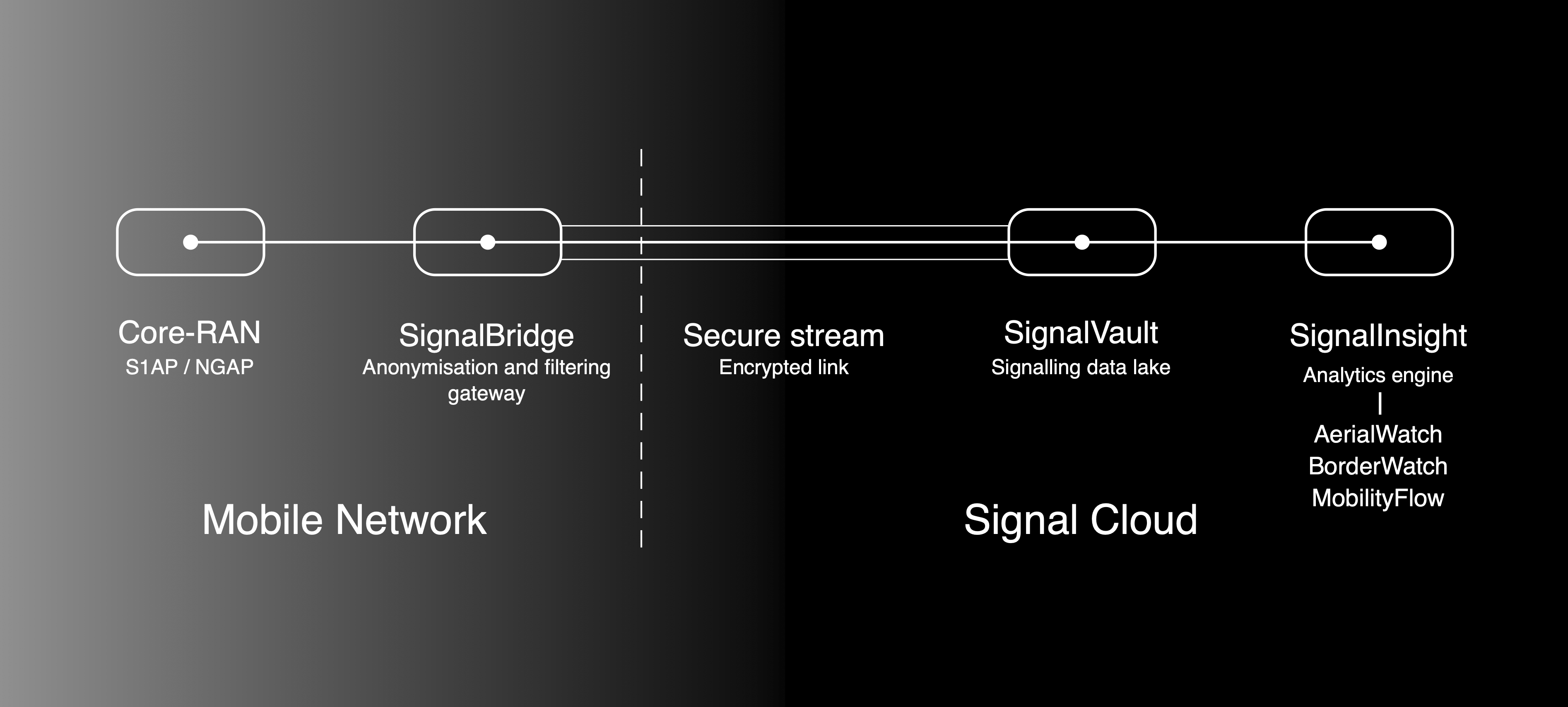
Signal Cloud introduces a structured architecture that allows signalling data to be analysed without compromising subscriber privacy. The platform separates the acquisition of signalling data from the large-scale analytics performed in the cloud.
Within the operator network environment, a component known as SignalBridge performs the initial processing of signalling traffic. This gateway receives signalling packets from passive monitoring systems, decodes the protocols, extracts relevant events, and anonymises sensitive identifiers before exporting the data to the analytics platform.
Once anonymised, the signalling events are transmitted through a secure streaming pipeline into the Signal Cloud environment. There, the data is stored within a scalable storage system called SignalVault and analysed by the SignalInsight analytics engine. This layered architecture allows operators to maintain control over subscriber identity information while enabling powerful cloud-based analytics.
SignalBridge: Operator-Side Processing
SignalBridge is deployed within the mobile network operator environment and acts as the secure entry point for signalling analytics. Its role is to process raw signalling traffic and convert it into structured events that can be safely exported from the network.
The gateway begins by decoding signalling messages using the relevant ASN.1 protocol definitions for S1AP and NGAP. This process transforms packet-level signalling traffic into structured representations of control-plane procedures. Once decoded, the gateway extracts events corresponding to significant signalling procedures such as device registration, session establishment, handovers, and context releases.
A critical responsibility of SignalBridge is the anonymisation of subscriber identifiers. Signalling messages frequently contain identifiers such as IMSI, SUPI, temporary subscriber identifiers, and device identifiers. These values are replaced with anonymised tokens before any data leaves the operator environment. The anonymisation process is deterministic, allowing multiple events associated with the same device to be correlated without revealing the original identifier.
The mapping between original identifiers and anonymised tokens remains entirely within the operator network. This ensures that the analytics platform operates only on pseudonymised data while the operator retains the ability to investigate specific devices if necessary.
SignalBridge may also filter signalling fields that are not required for analysis, reducing data volume while preserving analytical value.
Secure Event Streaming
After processing and anonymisation, signalling events are transmitted to the Signal Cloud platform through a secure streaming layer. This stage is designed to support the extremely high data rates produced by mobile networks.
Large national networks can generate hundreds of thousands of signalling messages per second. Signal Cloud therefore uses high-throughput streaming mechanisms capable of ingesting continuous event streams with minimal latency. Events are typically encoded in structured formats suitable for distributed processing systems.
Because all sensitive identifiers have already been anonymised within the operator environment, the streaming layer does not carry subscriber identity information.
SignalVault: Cloud-Scale Storage
SignalVault provides the persistent storage layer of the Signal Cloud platform. It acts as a large-scale repository for anonymised signalling events.
The storage architecture is designed to support both real-time analytics and historical investigation. Signalling events are indexed by time and contextual identifiers, allowing analysts to reconstruct sequences of signalling activity associated with particular devices or geographic areas.
By retaining historical signalling data, SignalVault enables retrospective analysis of events that may only become significant after the fact. This capability is particularly valuable for anomaly investigation, model training, and long-term trend analysis.
SignalInsight: Analytical Processing
SignalInsight forms the analytical core of the Signal Cloud platform. It processes signalling events stored in SignalVault to identify patterns, correlations, and anomalies.
The analytics engine reconstructs behavioural sequences from individual signalling events. By correlating events associated with the same anonymised device identifier, the system can infer mobility behaviour, session lifecycles, and interaction patterns with the network infrastructure.
Statistical analysis and machine learning techniques can then be applied to these behavioural datasets. Baseline patterns of normal network activity can be established, allowing deviations from expected behaviour to be detected automatically.
Through this process, signalling data becomes a source of operational intelligence rather than simply a troubleshooting resource.
Intelligence Applications
The analytical capabilities of SignalInsight support a range of specialised intelligence applications built on the Signal Cloud platform.
One example is the detection of cellular-connected unmanned aerial systems. Devices operating at altitude often produce distinctive signalling patterns due to the radio environment and mobility characteristics associated with aerial movement. By analysing mobility behaviour and radio measurement patterns, the platform can identify devices whose signalling behaviour differs significantly from that of terrestrial devices.
Another application involves the analysis of device activity in sensitive geographic areas such as national borders. Signalling data provides a continuous record of device movement across network regions. By analysing these patterns at scale, the system can identify unusual cross-border mobility behaviour or sudden device appearances in sensitive areas.
More broadly, signalling analytics can reveal anomalous network behaviour associated with misconfigured devices, signalling storms, or unusual patterns of device activity. The same analytical techniques can also be applied to large-scale mobility analysis, providing aggregated insight into how devices move across regions over time.
Scalability
The scale of signalling data generated by modern mobile networks requires distributed processing architectures. Signal Cloud is designed to ingest and process extremely large event streams using scalable cloud infrastructure.
The platform can process billions of signalling events per day while maintaining the ability to analyse behaviour in near real time. Distributed storage systems and parallel analytics pipelines allow large datasets to be processed efficiently.
This scalability enables operators to analyse signalling behaviour across entire national networks rather than limiting analysis to small subsets of data.
Security and Privacy
A fundamental design principle of Signal Cloud is the protection of subscriber privacy. The system is structured so that subscriber identifiers are anonymised before leaving the operator environment.
This approach ensures that the analytics platform operates only on pseudonymised identifiers. Because the mapping between original identifiers and anonymised tokens remains under the control of the operator, the platform cannot independently identify subscribers.
By combining operator-side anonymisation with cloud-based analytics, Signal Cloud enables large-scale signalling intelligence while maintaining compliance with privacy and regulatory requirements.
Conclusion
Control-plane signalling represents one of the most detailed sources of operational data within telecommunications infrastructure. Every device interaction with the network generates signalling events that describe connectivity, mobility, and session behaviour.
Signal Cloud enables mobile network operators to convert this signalling activity into structured intelligence while maintaining strict privacy controls. Through a combination of operator-side anonymisation, scalable storage, and advanced analytics, the platform unlocks the analytical value of signalling data at national scale.
As mobile networks continue to expand and connect increasing numbers of devices, the importance of signalling intelligence will continue to grow. Platforms such as Signal Cloud provide the architectural foundation needed to analyse this data safely and effectively.
Read more about Signal Cloud at https://melrosenetworks.com/scloud.